
Gardening is one of those activities where the experienced and the inexperienced often look identical in spring. Everyone starts with soil, seeds, and good intentions. The difference appears by late summer — in whose plants are producing, whose pest problems got out of hand, whose second sowing of lettuce worked, and whose didn’t.
That difference is usually garden journaling. Not always, but often enough that it’s the first thing experienced gardeners recommend to beginners, and the first thing experienced gardeners credit when they look back at how they improved. The garden journal is where intuition becomes knowledge, where accident becomes method, and where this season’s failure becomes next season’s success.
This guide covers everything: why garden journaling works, what to record and when, how to use your notes for planning, and how to extend the practice from growing to harvesting to brewing. It links out to deeper guides on specific aspects of the garden journaling practice.
Why Garden Journaling Makes You a Better Gardener

Plants are slow. The distance between a decision and its consequences is measured in weeks and months. You apply fertilizer in March and see the result in June. You choose a planting location in April and don’t know it was wrong until August, when the plant fails to thrive.
This temporal gap is why garden journaling is so valuable: it bridges the distance between action and outcome. Without notes, the gardener is always working from imperfect memory — ‘I think I planted that in March’ rather than ‘I planted that on March 14th, with well-rotted compost, in the south-facing bed.’ The first is a guess. The second is information.
Garden journaling also externalizes the accumulated knowledge that experienced gardeners carry in their heads. What varieties performed well in this particular soil. Which corner gets waterlogged. How early the last frost typically arrives. This knowledge is hard-won and easily forgotten; a garden journal makes it permanent and searchable.
What to Record in a Garden Journal
The most useful garden journals are specific and consistent, not comprehensive. Trying to record everything produces a journal too time-consuming to maintain. Focusing on the details that actually affect results produces a journal that’s genuinely useful for planning.
Planting records
For every plant sown or transplanted: date, variety or cultivar, source (seed packet, cutting, nursery), location in the garden, and method (direct sow, transplant, propagation). This record is the foundation — everything else builds on knowing what was planted and where.
Growing observations
Regular notes on plant progress: first germination, first true leaves, first flowers, first fruit or harvest. Notes on problems — yellowing leaves, pest damage, wilting, disease — with dates. These observations turn the garden journal into a diagnostic tool. When something goes wrong, you have a timeline.
Harvest records
What was harvested, when, and how much. This information answers the gardening question most people can’t answer accurately: was that actually worth growing? A harvest record tells you the yield from each variety, which informs next year’s planting decisions far more reliably than memory.
Weather and conditions
Brief notes on significant weather events: late frosts, heat waves, periods of drought or heavy rain. Correlating these conditions with plant performance over several years reveals patterns specific to your garden and your microclimate.
Seasonal Planning With Your Garden Journal
The garden journal is most powerful not during the season but before it. The notes from last year’s growing season are the raw material for this year’s plan — what to plant more of, what to skip, what to try in a different location, what to try for the first time.
A pre-season planning session — in late winter or early spring, before the first sowings — works through the previous year’s journal and translates its findings into a plan: which varieties to order, which beds to rotate, what soil amendments to make, what the main goals for the season are. Garden journaling done this way is not just record-keeping. It’s a design process.
From Garden to Cup: Herbs, Harvesting, and Herbal Infusions
One of the most satisfying extensions of garden journaling is tracking the journey from growing to using — and nowhere is this more rewarding than with herbs grown for tea. A garden journal that follows a herb from seed to harvest to cup creates a complete record of the practice.
What to record in the herb section of a garden journal: planting date and method, first harvest date, drying method and duration, flavour notes from the first infusion, and blend experiments. These records are what separate a gardener who grows herbs casually from one who genuinely understands the plants they’re working with.
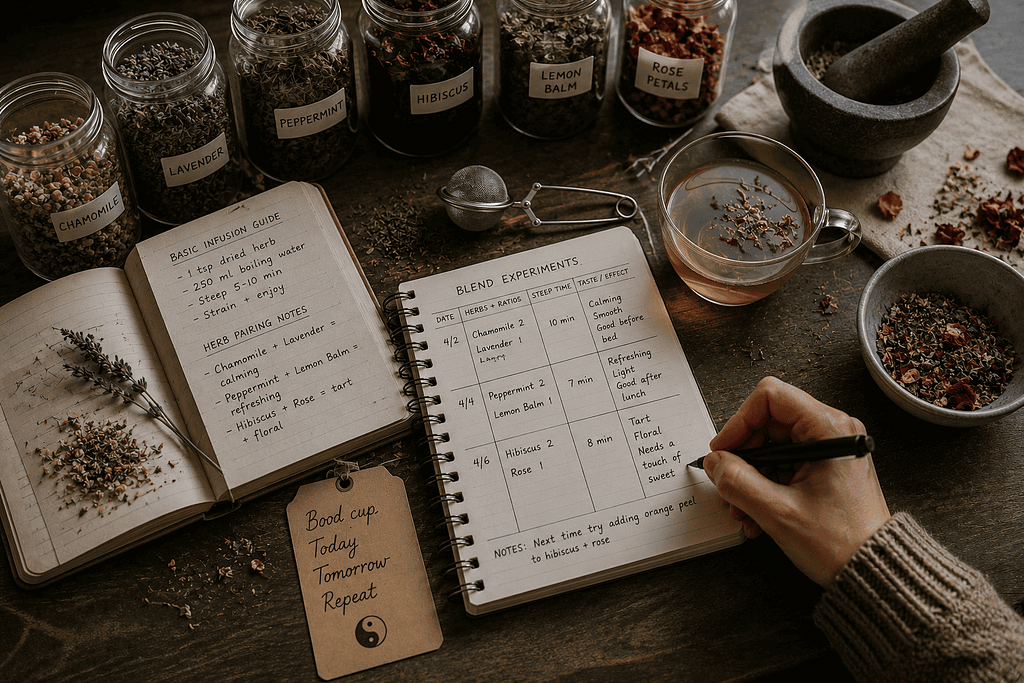
The process of blending and brewing herbs for infusion has its own learning curve — which herbs combine well, what ratios work, how long to steep each base. Recording experiments systematically is the fastest way to move from accidental good cup to repeatable recipe.
Garden Journaling for Small Spaces: Balconies and Containers
Garden journaling is not only for people with large plots. Balcony gardens and container growing benefit from journal records at least as much as traditional gardens — because the constraints are more precise and the margins for error are smaller. Container plants dry out faster, have less soil buffer, and need more frequent feeding. Tracking these variables produces noticeable improvements in results.
For balcony garden journaling, the most important records are: container size and soil type for each plant, watering frequency (which varies by season and container size), feeding schedule, and sunlight hours in different positions on the balcony. This information takes a season to gather and multiple seasons to fully use — another argument for starting the journal now rather than later.
Garden Journaling for Small Spaces: Balconies and Containers
Garden journaling is not only for people with large plots. Balcony gardens and container growing benefit from garden journaling records for the same reasons in-ground gardens do — and in some ways more so, because the variables are more concentrated and the learning curve for container growing is steeper.
Container growing has specific garden journaling needs: watering frequency matters more (containers dry out faster than in-ground beds), soil condition changes each season and needs refreshing, and container size affects root development and yield in ways that take time to understand. A garden journal that records these specifics — which containers produced well, which compost mixes worked, how often each plant needed water — becomes a practical guide to the microclimate of your specific balcony.
For balcony gardeners with limited space, the most useful garden journaling entries track yield per pot: how much did the plant actually produce, relative to the space it occupied and the attention it required? This information is nearly impossible to hold in memory across seasons but straightforward to track in a garden log.
Year-Round Garden Journaling: What to Record in Each Season
Garden journaling is often associated with the growing season, but a year-round practice captures the full cycle — and the most useful planning entries are frequently made in the months when nothing appears to be happening.
Winter is planning season. Use January and February to review the previous year’s garden journaling notes, assess what performed well, and sketch the layout for the coming season. Seed catalogues arrive in January; your garden journal entries from last summer tell you which varieties are worth ordering again and which aren’t. A winter review of an hour produces a planting plan that’s grounded in real experience.
Spring is the most intensive garden journaling period. Sowing dates, germination rates, first transplanting dates, late frost notes, early pest appearances — all of this happens quickly and is hard to reconstruct afterward. Keep the journal open and accessible during March, April, and May. Short garden journaling entries made daily are more useful than detailed entries made weekly from memory.
Summer garden journaling focuses on observation: what’s performing, what’s struggling, and why. Record harvest dates and quantities. Note what the weather has been doing and how plants have responded. Pest and disease appearances with dates allow you to anticipate and address the same issues earlier in future years.
Autumn is evaluation and closing. What would you grow again? What would you drop? What do you wish you’d done differently? These garden journaling notes, written while the season is fresh, are the foundation of next year’s better garden. Also record any soil amendments or winter preparation done before the cold arrives.
Building a Personal Reference Through Garden Journaling
Over multiple seasons, garden journaling creates something more than a record — it creates a personal reference document tailored to your specific conditions. The local frost dates you’ve observed, the varieties that reliably perform on your soil, the pests that appear in the second week of June — this knowledge doesn’t exist in any book, because no book was written about your garden.
Some experienced gardeners create a summary section at the back of each journal: a list of what was grown, key dates, what succeeded, what failed, and one or two lessons to carry forward. This summary takes thirty minutes to write at the end of the season and saves hours of cross-referencing in future years of garden journaling.
Your garden journal also accumulates information about suppliers and sources: which nursery had the best seedlings, which seed company’s germination rates are reliable, where the best compost comes from locally. These garden journaling notes are easily overlooked but genuinely useful when planning next season’s purchases.
Sharing Your Garden Journaling: Community and Connection
A garden journal is a private document, but the knowledge it contains is highly shareable. Experienced gardeners are generous with information, and consistent garden journaling gives you specific, credible observations to contribute to those conversations.
In gardening communities — allotment associations, community gardens, online growing groups — the most useful contributions are specific reports grounded in garden journaling: ‘I grew this variety on north-facing clay soil and it produced well from mid-July’ is more valuable than any generic recommendation. Your garden journaling practice makes you this kind of contributor.
Setting Up Your Garden Journal: Format and First Entries
The format of a garden journaling record matters for consistency. A journal that works with how you actually garden — rather than imposing a structure that requires adaptation — gets used. One that doesn’t match your habits gets abandoned.
For most gardeners, a simple dated log works best: one entry per gardening session or notable observation, with a date, brief description, and any relevant measurements or counts. Some gardeners prefer a grid format with columns for date, plant, action, and result. Others use a sketchbook approach, with rough drawings of the garden layout annotated with notes. Any of these garden journaling formats work, provided you use it consistently.
The first entries in a new garden journal should capture the starting state: what’s currently in the garden, what the soil condition is like, what the aspect and drainage are, any known pest or disease history. This baseline makes everything that comes later more meaningful — you’re not just recording what happened, but what happened in context.
Date every entry. This is the one non-negotiable of garden journaling. A record without dates is a collection of observations; a record with dates is a dataset. The date is what allows you to correlate sowing with germination, weather with disease, harvest with timing. Without it, the garden journaling record loses most of its analytical value.
A garden journal begun in the first season of growing pays dividends from the second season onward. The knowledge it holds is specific, earned, and directly applicable — the kind of practical understanding that can’t be found in any general planting guide because it was built in your garden, with your soil, under your conditions.
The most useful thing a new gardener can do is start garden journaling from the very first seed sown, even before there is anything to report. The habit of opening the journal, writing the date, and recording what was done that day is the foundation of effective garden journaling. Everything else grows from there, in the same way the garden does: slowly, incrementally, and always more productively than expected.
For evidence-based planting guides and seasonal advice specific to your region, the University of Minnesota Extension’s vegetable gardening resources are free, detailed, and written by horticulture specialists.
Explore the Scribovo Nature & Garden collection — garden journals and herb logbooks for every kind of growing space, available on Amazon.
Published by Scribovo — journals, logbooks and planners for thoughtful adults