
At some point, most adults stop making things. Not because they lose interest, but because the bar quietly rises. Somewhere between childhood and adulthood, creativity becomes something that belongs to other people: the talented ones, the trained ones, the ones with time and a proper studio. Everyone else watches.
This is not an accurate picture of what creativity is or what it is for. Creative expression does not require skill, training, or a particular personality type. It requires a surface, something to make marks with, and enough permission to begin. That last ingredient is harder to come by than it sounds, but it is the only one that matters.
This guide covers the real value of creative relaxation for adults: what the research says about coloring and creative practice, why low-barrier formats like adult coloring books work so well, how romantic and playful themes unlock creative engagement, and how to build a creative habit that actually survives contact with a busy week.
Why Adults Stop Creating And What It Costs Them
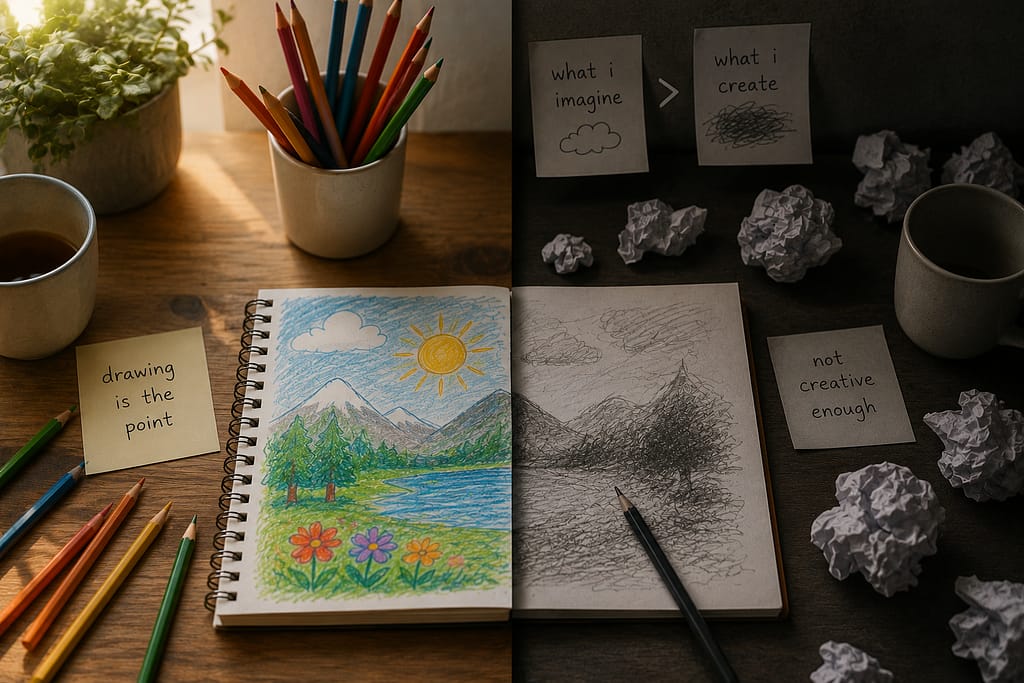
Children draw without hesitation because the outcome is irrelevant. The drawing is the activity; the drawing is the point. Somewhere around the age of eight or nine, this changes. Self-evaluation enters the picture. The gap between what is imagined and what the hand produces becomes visible, and visible enough to be discouraging. By the time most people reach adulthood, they have quietly decided that they are not creative people.
This is a learned conclusion, not a fact. It is the result of decades of evaluating creative output against standards that were never meant to apply to personal creative practice. The comparison that matters, the child’s drawing against the child’s imagination, has been replaced by one that does not serve any useful purpose: the adult’s coloring page against a professional artist’s portfolio.
What this costs is significant. Creative activity is not a luxury. It is one of the most reliable ways the human mind processes experience, regulates emotion, and generates a sense of personal agency. Adults who maintain any form of creative practice, regardless of skill level, consistently report lower stress, better mood, and a greater sense of satisfaction with their daily lives than those who do not.
The entry point does not need to be ambitious. It does not need to be art. It needs to be making something, regularly, without the pressure to produce anything worth showing anyone. That is the entire foundation of creative relaxation.
The Science of Creative Relaxation
The connection between creative activity and stress reduction is not a wellness platitude. It is supported by a consistent body of research. Creative activity engages the brain’s default mode network, the mental state associated with imagination and self-reflection, while simultaneously reducing activity in the prefrontal cortex, the seat of self-criticism, overthinking, and rumination. The practical result is a mental state that feels simultaneously calm and engaged, the state commonly described as flow.
Coloring achieves this state particularly reliably. The activity is constrained enough to focus attention, there are lines, there are choices about colour and pressure, but open enough to engage creativity. It does not require verbal thinking. It does not require planning. It requires only presence and the repetitive, absorbing motion of filling a space with colour — the simplest form of creative relaxation available to anyone.
Studies on art-based therapies consistently find that even short sessions of creative activity, fifteen to thirty minutes, produce measurable reductions in cortisol levels and self-reported stress. The effect does not depend on the quality of the output or the experience level of the person doing it. A first-time colorist and a practiced one benefit in comparable measure. The brain responds to the act of creating, not to the result.
This is the principle that makes adult coloring books one of the most effective stress-relief tools in the category. They deliver the neurological benefit of creative relaxation with a technical barrier low enough that almost anyone can begin immediately.
Adult Coloring Books: The Accessible Entry Point into Creative Practice
The adult coloring book is not a simplified version of a real creative practice. It is a specific and effective format designed to do something that more open-ended creative formats often fail to do: get you started.
The blank page is genuinely intimidating. This is not a weakness; it is a documented psychological response to unstructured possibility. When the page offers too many choices with no constraints, decision fatigue and self-doubt fill the space that creativity should occupy. Structure helps. A page that already has a composition, with shapes defined, relationships established, and decisions already made about what goes where, removes the cognitive load of composition and leaves only the pleasure of colour and creative relaxation.
For adults who have not engaged in any creative activity for years, this is precisely the right starting point. The coloring book says: here is the space, here are the boundaries, now simply respond to it. What you bring is colour, attention, and a few minutes of uninterrupted time. What you get back is a completed page, a quieter mind, and the first proof that creative relaxation is genuinely accessible — for anyone, at any skill level.
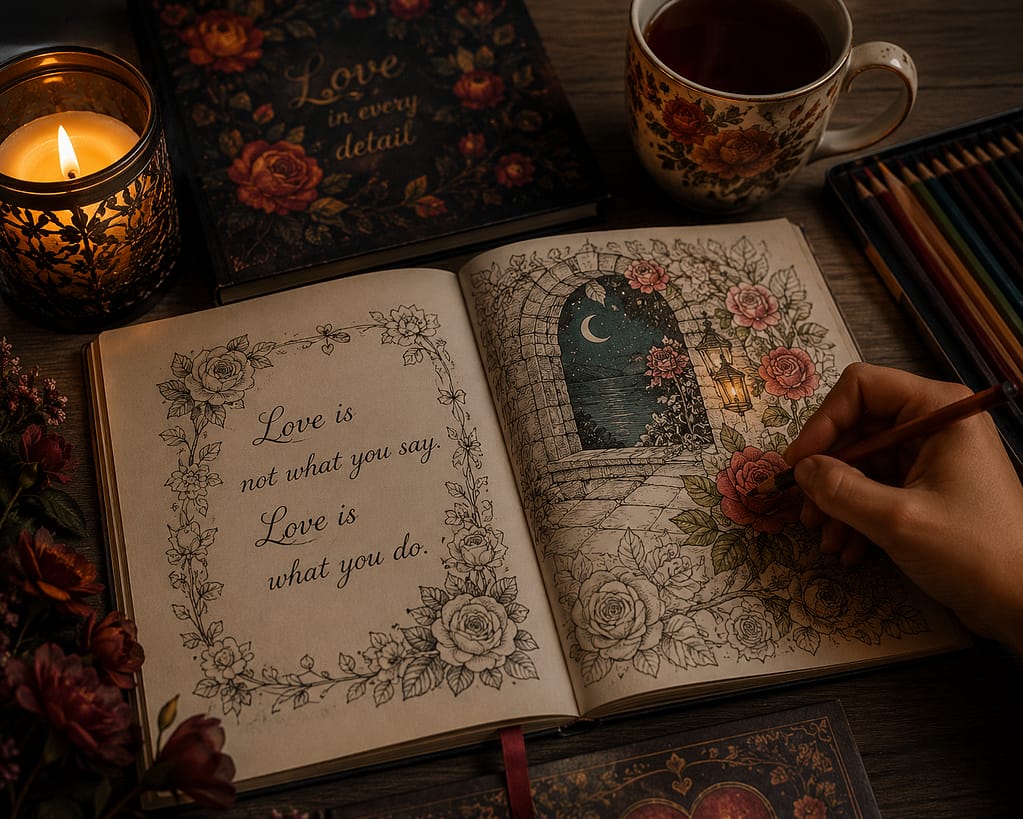
Themed coloring books extend this further. A book built around a consistent aesthetic and subject matter, romantic imagery, botanical illustration, dark and gothic design, invites you into a world rather than just onto a page. The theme becomes part of the experience, adding an emotional layer that pure abstract coloring lacks. Love quotes paired with illustration offer something particularly rich: words and image reinforce each other, and the act of coloring around meaningful language gives you time to sit with it rather than simply reading past it.
Why Romantic and Love Themes Resonate in Creative Practice
Not all creative content produces the same emotional response, and creative self-care benefits from choosing formats and themes that genuinely engage you rather than ones that are merely available. For many adults, romantic and love themes create a particularly strong draw.
This is not simply a matter of taste. Romantic and love-themed imagery engages memory, aspiration, and emotion simultaneously. Coloring a page filled with love quotes and affectionate imagery is not just a visual activity. It is an engagement with something personally meaningful, with how you feel about the people you love, with the language of affection, with the part of your inner life that does not get much surface area in a busy day.
The quote becomes part of the creative relaxation experience, not just a caption. Some people find that coloring around a love quote is one of the few moments in a day where they actually think about what they value most, without the interruption of a notification or the pressure of a task list.
Creative relaxation with love themes also comes in more than one register. Warm, romantic, and sweetly affectionate is one mode. Dark, playful, and irreverent is another, and it serves a different audience just as well. A coloring book built around gothic love imagery, darkly affectionate quotes, and strange beauty appeals to the couples who would rather share a book about skeletons in love than conventional Valentine imagery. Both are valid creative relaxation tools; the question is which one actually makes you want to pick up a pencil.
The Mindfulness Layer: Coloring as Focused Attention
One of the most consistent findings in research on coloring for adults is how effectively it functions as an informal mindfulness practice. Mindfulness, the practice of sustained, non-judgmental attention to the present moment, is well-established as a tool for stress reduction, anxiety management, and emotional regulation. It is also a practice that many people find difficult to access through formal meditation: sitting still with an empty mind is harder than it sounds.
Coloring solves this creative relaxation challenge by giving the mind something specific to attend to, colour, pressure, direction, boundary, that is absorbing enough to crowd out rumination without demanding the kind of focused cognitive effort that produces its own stress. The hand is occupied; the mind follows.
The effect is not identical to formal meditation, but the practical benefits overlap significantly: reduced heart rate, lower cortisol, a quieter internal monologue, and a sense of returning to a calmer baseline. For people who find formal mindfulness practices difficult or inaccessible, adult coloring books offer a reliable and low-barrier alternative to creative relaxation.
This is particularly relevant for adults whose stress tends to be cognitively driven, people who overthink, replay conversations, or find it difficult to mentally switch off from work. Creative absorption is one of the most effective interruptions to this pattern, and coloring is one of its most accessible forms. Fifteen minutes of focused coloring achieves more mental reset than fifteen minutes of passive scrolling, even though the latter feels like rest.
Creative Expression as a Couple Activity
Many couple activities require logistical coordination, energy, and often money. A shared creative relaxation activity at home requires almost none of these things, which makes it one of the most consistently achievable ways to spend quality time together.
Creative activities have a particular quality that makes them well suited to couple time: they occupy the hands while leaving the emotional space open. A couple coloring together is not staring at a screen in parallel. They are doing something together, physically present, sharing a table and materials, while maintaining enough relaxed attention to talk naturally, without the pressure of a structured conversation.
Love-themed creative formats add a dimension that generic coloring books lack. When the content itself is about love, connection, and affection, the activity becomes an implicit acknowledgment of those things. The conversation that emerges from it tends to be warmer and more personal than what emerges from watching television together.
For couples who want a regular ritual that reliably produces connection without requiring significant energy, on a weeknight, after a difficult day, when neither person has much to give, a shared creative session built around love-themed content is a dependable option. It does not need to be long. Thirty minutes achieves the effect. The point is not to produce anything. The point is to be in the same space, doing the same thing, with something that already speaks the language of your relationship.
Moving From Coloring to Wider Creative Expression
Adult coloring books are a starting point, not a ceiling. For many people, a regular coloring practice opens a door that has been closed since childhood: the door to making things, and to enjoying the making without needing a result to justify it.
From coloring, the natural progressions are several. Doodling, freehand drawing without a compositional goal, develops the hand-eye relationship and the comfort with the blank page that coloring starts to build. Watercolour and simple painting techniques extend the colour vocabulary. Mixed media journaling adds written reflection to visual expression, creating a personal record that is both made and written. Each step is a natural extension of what came before; none requires a formal transition.
None of these next steps require a decision to become more serious about creativity. They happen naturally when you are ready for them, often without noticing, because the creative relaxation habit is already established and the resistance has already diminished. The most important thing the coloring book does is not teach technique. It reinstates the habit of making things, which is the only prerequisite for everything that follows — and the core purpose of any creative relaxation practice.
Art journaling, combining visual elements with personal writing in a bound journal, is one of the natural landing places for adults who move through a coloring practice into something more open-ended. It may be a direction this site explores in future guides, depending on how the creative relaxation community here develops.
Building a Creative Relaxation Practice That Lasts
The most common failure mode in any creative self-care practice is the same as in any other wellbeing practice: beginning with enthusiasm, continuing for a few weeks, and stopping when life intervenes, then not starting again because restarting feels like failure.
The antidote is to make the creative relaxation practice small enough that it does not require enthusiasm to maintain. A creative relaxation session that takes thirty minutes requires a certain amount of motivation. One that takes ten minutes requires almost none. The shorter version is the one that actually happens on difficult days, and difficult days are when the benefit is greatest.
Keep materials visible and accessible. A coloring book and a set of pencils on a desk or coffee table are used. The same materials in a drawer are not. The visible creative relaxation practice is the actual practice.
Pair the creative relaxation session with something already in your routine. After dinner, during a slow morning, alongside a cup of tea at the weekend. Attaching a new habit to an established one dramatically increases the likelihood it will persist. The creative session does not need to be its own event. It can be the ten minutes before you pick up your phone in the evening, or the quiet half-hour on a Sunday that you were going to spend on your phone anyway.
Progress does not need to be tracked with metrics. The point is not to produce a portfolio. The point is to have spent some time making something, regularly, for the cumulative benefit that regularity produces over months.
What Regular Creative Relaxation Builds Over Time
The short-term benefit of a creative relaxation practice is a quieter mind and lower stress in the hours that follow. The long-term benefit is something more substantial: a changed relationship with your own creativity.
Adults who maintain even a modest creative relaxation practice for six months consistently report that they feel more comfortable with ambiguity, more willing to attempt new things, and less self-critical across multiple areas of life, not just in their creative work. The permission to make imperfect things in a low-stakes context generalises. The habit teaches tolerance for process and uncertainty that extends well beyond the coloring book.
It also builds confidence in a direct sense: you have evidence, accumulated over months, that you can and do make things. This sounds modest, but for adults who have spent years convinced they are not creative people, it is genuinely significant. The adult coloring book is not proof that you are an artist. It is proof that you make things, which is the same quality, expressed differently.
Creative relaxation is not a shortcut to becoming a skilled visual artist. It is a creative relaxation practice that reinstates something most adults have quietly given up, the simple and reliable satisfaction of making something with your hands, and makes it available every day, in fifteen minutes, regardless of skill level, inspiration, or how much energy the day has already consumed.
For accessible, research-based guidance on how creative activities support mental health in adults, the American Art Therapy Association offers a range of free resources covering the therapeutic value of art-making across age groups and contexts .
Explore the Scribovo Art & Creativity collection — doodle journals and creative coloring books for adults, available on Amazon.
Published by Scribovo — journals, logbooks and planners for thoughtful adults.