
The sky is the most accessible and most underused scientific subject available to anyone, anywhere, for free. You need no equipment to begin. No qualification. No special location. You need to go outside, look up, and pay attention to something that most people walk past without noticing.
Sky observation is the practice of looking deliberately — at stars, planets, clouds, weather patterns, and the occasional unexplained phenomenon — and keeping a record of what you find. It sits at the intersection of science and attention: it trains you to notice more, to record carefully, and to build understanding over time from your own observations.
This guide covers all forms of sky observation: stargazing, cloud and weather watching, atmospheric phenomena, and other sky events worth logging. It links to deeper guides on each practice.
Why Sky Observation Builds Something Ordinary Looking Cannot
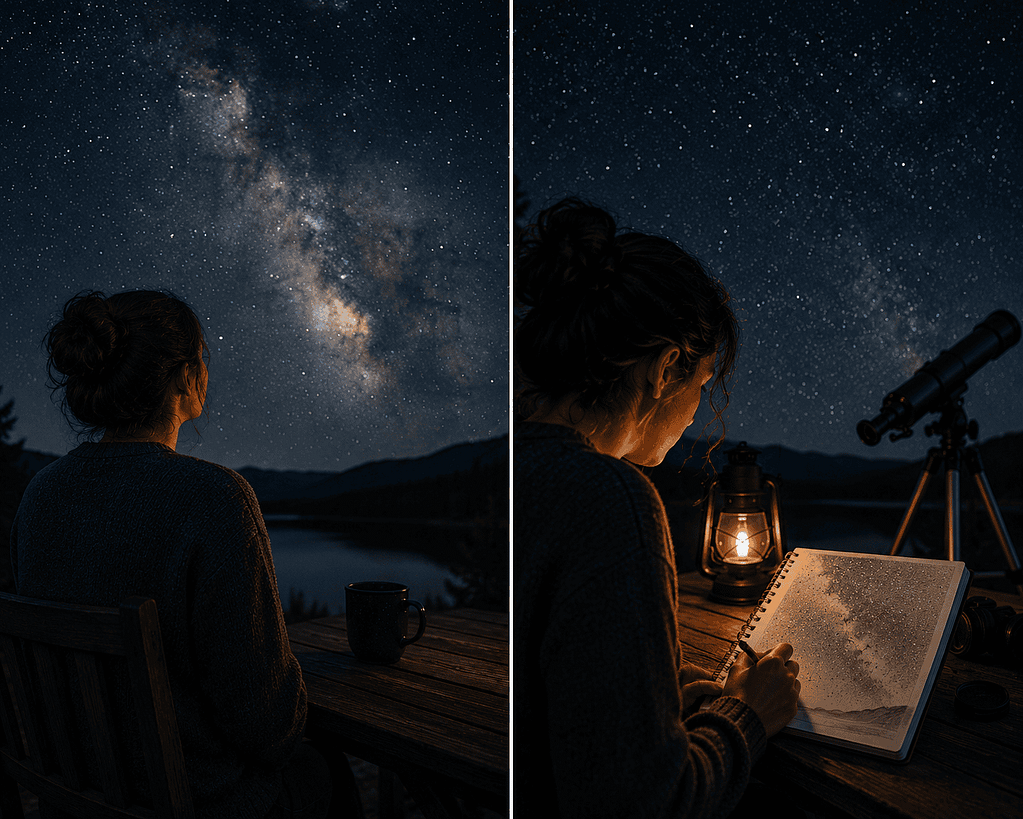
Looking at the night sky without recording what you see is pleasant. Looking at the night sky and writing down what you see is a completely different practice. The act of describing an object — its position, its brightness, its colour, any structure visible — forces you to look more carefully than you otherwise would. You cannot describe what you haven’t actually observed.
Over time, a sky observation log becomes something that spontaneous looking cannot produce: a record of patterns. After a year of logging, you can compare this October’s sky conditions to last October’s. After three years, you know which planets are typically visible in summer, how often your site allows deep-sky observation, what the cloud patterns in your area tend to be.
This kind of accumulated knowledge was once the exclusive province of professional astronomers. Amateur sky observation has contributed meaningfully to astronomical research — variable star monitoring, comet and asteroid sightings, meteor counts. The discipline of keeping a log is what separates observation from mere looking.
Stargazing: The Foundation of Sky Observation
Stargazing is the most common entry point into sky observation, and the most well-documented. It can begin with nothing more than dark-adapted eyes and a clear sky. The first things to learn to recognize — the brightest stars, the most prominent constellations, the planets — are visible without any equipment and recognizable within a few sessions of dedicated attention.
A stargazing observation log should record, for each session: date, time, and location; sky conditions (transparency and seeing — two distinct qualities that affect what’s visible); equipment used; and specific objects observed, with notes on what was visible. Sketches, even rough ones, are more useful than written descriptions for complex objects like galaxies and nebulae.
The log becomes more useful with every entry. Within a year, it’s a record of the sky from your specific location, at your specific skill level, with notes on what has improved and what hasn’t. This is the kind of document that’s impossible to reconstruct from memory — and genuinely useful for planning future sessions.
Atmospheric Phenomena: The Day Sky’s Equivalent
Most people have seen an atmospheric phenomenon without knowing what it was: a ring around the sun, bright spots of light flanking it at the same altitude, a curved band of colour high in the sky that looked like an upside-down rainbow. These are ice crystal phenomena — optical effects produced by the refraction and reflection of light through hexagonal ice crystals in high cirrus clouds.
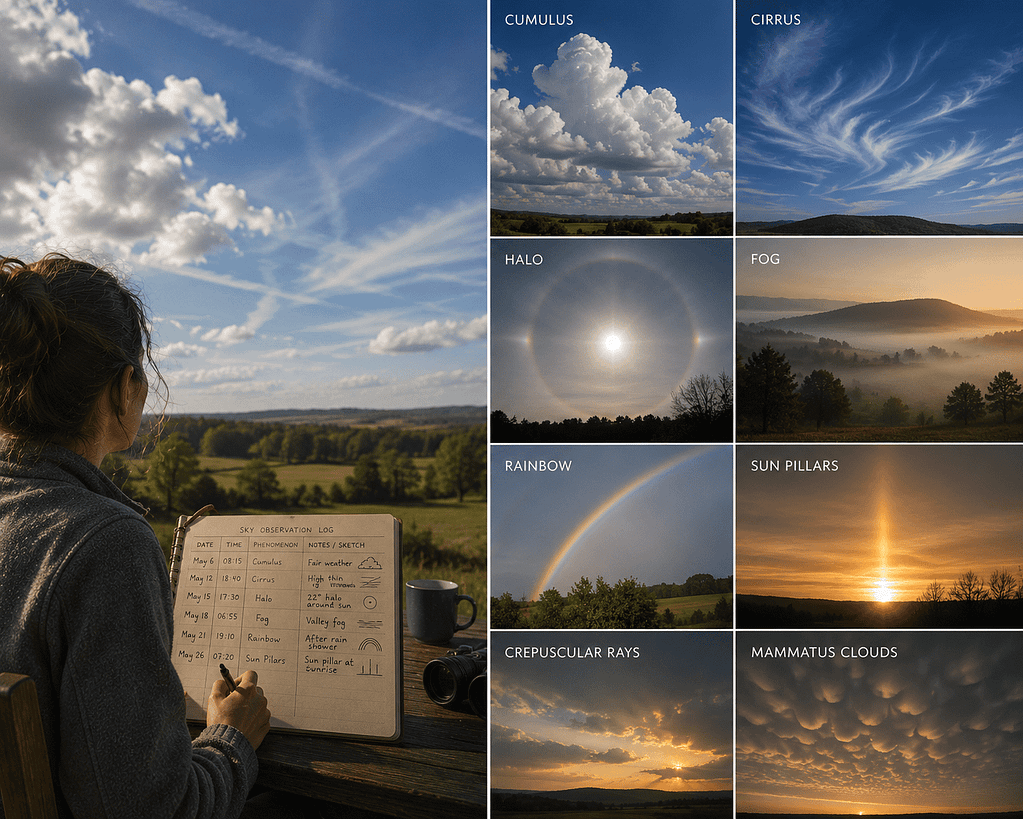
Atmospheric phenomena are the daytime equivalent of astronomical events, and they’re far more frequent. A sky observation log that includes atmospheric phenomena has entries to make in most weeks, not just on clear nights. They’re also more accessible: no special equipment, no dark location required, no early morning start.
What to record: the type of phenomenon, date and time, cloud conditions, duration, direction from the observer, and a sketch or photograph. Correlating atmospheric phenomena with weather patterns — what followed a halo display, what cloud type preceded a circumzenithal arc — builds a practical understanding of atmospheric science.
Cloud and Weather Observation
Cloud watching is a legitimate scientific practice with a 200-year history. The cloud classification system — cumulus, stratus, cirrus and their variants — was developed by an amateur meteorologist in the early nineteenth century. Modern citizen science weather observation contributes to forecasting models that professional meteorology relies on.
For the amateur sky observer, cloud and weather journaling serves a different purpose: understanding the local patterns that affect when and what you can observe. A log of weather conditions over a year reveals the most consistently clear weeks in your area, the typical onset of the rainy season, the periods when atmospheric turbulence makes planetary observation difficult. This information is not available from weather apps, which report averages rather than local patterns.
What to log: daily sky conditions (clear, partly cloudy, overcast), notable cloud formations (with identification), precipitation events, unusual optical phenomena, temperature and pressure if you have a weather station. Even brief daily entries — a sentence or two — build into a substantial dataset over months.
Getting Started With Sky Observation Tonight
The barrier to starting a sky observation practice is almost entirely psychological. The actual requirements are minimal: a clear-ish sky, a notebook, something to write with, and the willingness to go outside and look up for twenty minutes.
The first session of sky observation doesn’t need to be productive in any conventional sense. Go outside, let your eyes adapt to the dark for fifteen minutes, look at whatever is visible, and write down what you see — no matter how vague. ‘Bright star low in the southwest, one planet visible near the moon, clouds covering the rest’ is a legitimate first entry. The important thing is that it’s dated, located, and real.
Add equipment when you want more. Binoculars before a telescope, always — they’re cheaper, more versatile, and show you enough of the sky to understand what you’re looking at before you start magnifying individual objects. The Scribovo Sky & Science LOOK UP! series includes sky observation logbooks for different practices — stargazing, weather and cloud watching, and unusual sky events.
Getting Started: What You Actually Need for Sky Observation Tonight
The practical requirements for starting a sky observation practice are minimal to the point of being almost embarrassing. A notebook. Something to write with. The ability to go outside and look up. That is it.
Everything else — apps, star maps, binoculars, telescopes — is useful but not required to begin sky observation. The first session should be as frictionless as possible: go outside at a reasonable hour, look at whatever is visible, write down what you see and where you see it. That entry is the foundation of your sky observation log. From there, curiosity does the work.
Red light torches preserve night vision and allow you to write sky observation notes without losing your dark adaptation. A free star map app like Stellarium helps identify what you’re looking at. These are useful additions, but the log comes first.
Planetary Sky Observation: The Moving Targets
Planets are among the most accessible objects for sky observation, and among the most rewarding to track over time. Unlike stars, which appear fixed relative to each other, planets move against the background of stars — hence the Greek root for ‘wanderer.’ Tracking this movement over weeks and months is one of the most satisfying applications of a sky observation log.
With the naked eye, you can observe five planets in sky observation without optical aid: Mercury (low on the horizon, best seen just after sunset or before sunrise), Venus (the brightest object in the sky after the moon), Mars (distinctly reddish), Jupiter (very bright, often the brightest apparent star in the sky), and Saturn (yellow-white, steady glow).
Record each planet’s position relative to nearby stars and its apparent brightness in your sky observation log. Over weeks, the movement becomes visible. Over months, you’ll observe Venus cycling between evening star and morning star, Mars brightening and dimming as Earth’s orbit brings it closer and farther, and the slow, stately progress of Jupiter and Saturn across the sky.
With binoculars, Jupiter’s four Galilean moons become visible — tiny points of light that change configuration from night to night. Recording their positions is a centuries-old sky observation practice that links your log to the notebooks of professional astronomers going back to Galileo.
Equipment for Sky Observation: What’s Worth Having and When
Sky observation is one of the few scientific practices where entry-level equipment produces genuinely meaningful results. You don’t need a telescope to maintain a valuable sky observation practice. Many experienced amateur astronomers use binoculars as their primary instrument for years.
Binoculars — 7×50 or 10×50 are standard recommendations for astronomical sky observation — open up the Milky Way, reveal detail in star clusters, show the phases of Venus, and display Jupiter’s moons. They’re also useful for cloud observation and atmospheric phenomena during daylight sky observation. If you’re adding one piece of equipment to a sky observation practice, binoculars are the first choice.
A small telescope adds lunar detail, Saturn’s rings, and views of more distant deep-sky objects. The telescope isn’t a starting point for sky observation — it’s the next step after you’ve established what you want to observe and built a log that tells you what you’ve already seen.
Whatever equipment you use, record it in your sky observation log entries: ‘Seen with 10×50 binoculars from urban garden, limiting magnitude approximately 4.5.’ This context makes your sky observation records comparable across sessions and meaningful to anyone who reads them.
Making Sky Observation a Consistent Practice
Sky observation is subject to a particular kind of procrastination: it’s always going to be better tomorrow when the weather’s clearer, the moon is in a better phase, you’re less tired. The sky observer who only goes out under perfect conditions rarely goes out.
The solution is to lower the threshold for a sky observation session. Five minutes counts. A partial view through broken cloud counts. A brief observation from the back door rather than a dedicated viewing spot counts. The habit of going out and looking — even briefly, even when conditions aren’t ideal — is what produces the accumulated log that makes the practice valuable.
Set a minimum viable sky observation session: on any night that’s not actively raining, spend at least five minutes outside noting the current conditions. This might produce nothing more than ‘overcast, no objects visible’ — which is itself a data point. Weather pattern recognition through sky observation over months and years requires records that include the cloudy nights as much as the clear ones.
The Sky Observation Log: How to Structure Your Records
A sky observation log is most useful when it’s consistent in format — when each entry captures the same categories of information so that records from different sessions can be compared. The categories don’t need to be elaborate, but they should be fixed.
A minimal but effective sky observation log entry includes: date and local time, location (especially if you observe from different sites), sky conditions (transparency and seeing, rated on a simple 1-5 scale), limiting magnitude (the faintest star you can see with the naked eye — a proxy for sky darkness), and a brief record of what you observed. Everything beyond this is optional enhancement.
Some sky observation logs include a weather section — temperature, humidity, wind — which is useful for correlating conditions with observation quality over time. Others include equipment notes and any unusual events (satellites, meteors, atmospheric phenomena). The key is to decide on a format and use it consistently. A log you can search and cross-reference is worth many times more than one you can only browse.
Sky observation is, at its best, a practice of noticing. The sky is always there. What changes is the habit of looking at it deliberately — and the log that captures what you found when you did. Over time, those entries add up to something genuinely unusual: a personal record of the sky from one place, over years, in one person’s hand.
For daily sky events, moon phases, planet visibility, and astronomy news, EarthSky is a reliable and accessible resource for observers at every level.
Explore the Scribovo Sky & Science collection — LOOK UP! observation logbooks for stargazers, cloud watchers, and sky enthusiasts, available on Amazon.
Published by Scribovo — journals, logbooks and planners for thoughtful adults