
Most trips are remembered in the same way: a few strong images, a handful of stories that get told at dinner parties, and a vague sense of how it felt to be somewhere else. The details — the name of the side street with the good coffee, the exact shade of the water, the thing the local said that reframed everything — are gone within weeks.
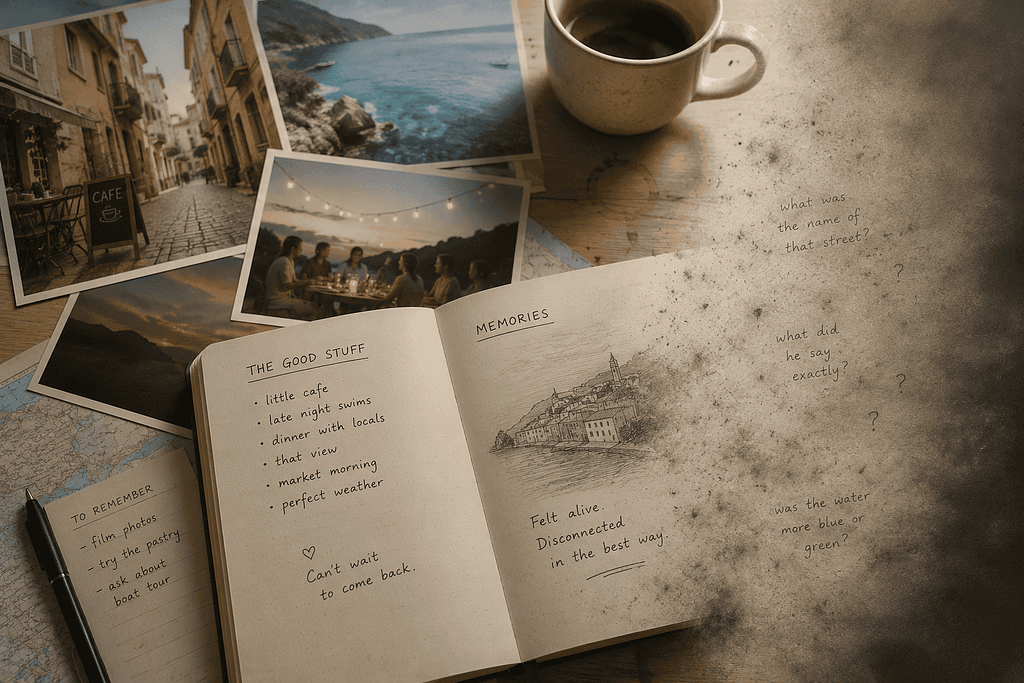
Travel journaling is the practice of writing those things down before they disappear. Not as a chore, not as a diary obligation, but as a way of staying present in your own experience and building something you’ll actually want to return to. Done well, travel journaling changes how you travel, not just how you remember it.
This guide covers everything: why travel journaling works, what to write and when, how to choose the right format, and how to use a journal throughout the full arc of a trip — from planning to the flight home. It also links out to deeper guides on specific aspects of the practice.
Why Travel Journaling Changes the Way You Travel
The argument for travel journaling isn’t sentimental, it’s cognitive. Writing about an experience within hours of having it dramatically improves how much you retain and how accurately you remember it. The act of putting words to what you saw forces you to process it — to find the language for something that was previously just sensation.
But travel journaling also changes the trip while it’s happening. When you know you’re going to write about the day, you pay attention differently. You notice more. You ask questions you’d otherwise let pass. The journal becomes a reason to look harder, to stay curious, to resist the urge to consume the place and move on.
There is also the question of what you’re building. A travel journal from a significant trip is one of the few personal documents that improves with age. Reading what you wrote five years ago about a city you know well now is a completely different experience from looking at photographs. The writing contains the self who was there in a way that images cannot.
What to Write In a Travel Journal — And What to Skip
The most common mistake in travel journaling is trying to document everything. Chronological summaries of what you did and ate are useful as a record, but they make for dull reading. The goal is not a complete report. It’s a vivid one.
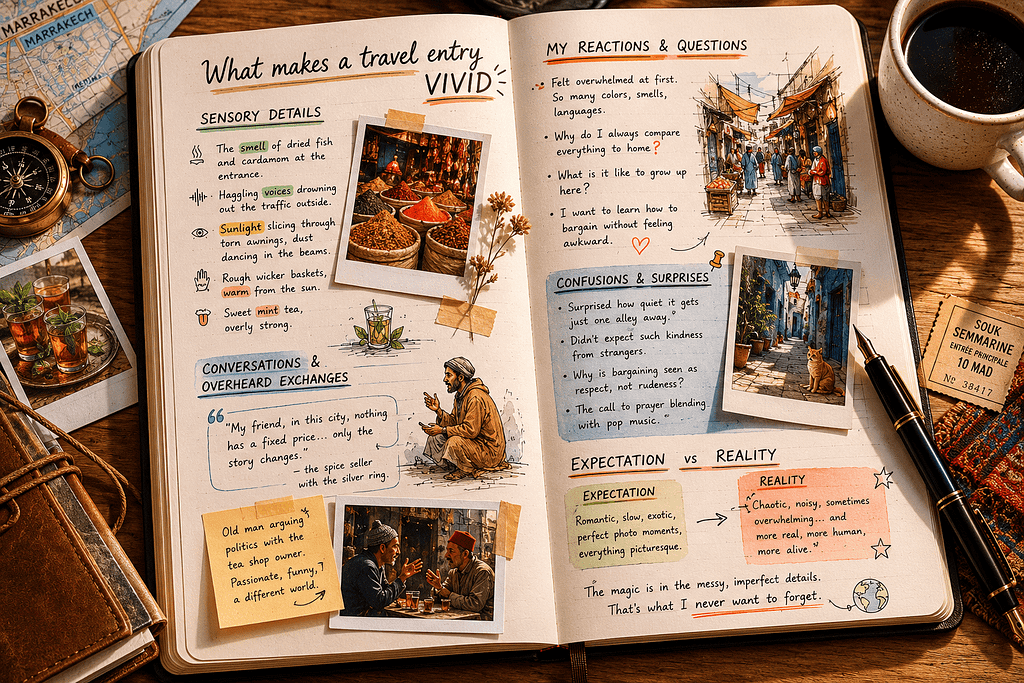
What makes a travel entry vivid: specific sensory details (not ‘the market was busy’ but ‘the smell of dried fish and cardamom at the entrance, the sound of hagglingdrowning out the traffic outside’); conversations and overheard exchanges; your own reactions and questions; things that confused or surprised you; the gap between expectation and reality.
What to skip: the itinerary you already have elsewhere, the hotel rating you can find on a review site, descriptions of things that can be easily photographed. Your job as a travel journalist is to write the things the photograph can’t capture.
A useful framing: write for yourself in ten years, who will want to know not just where you went but who you were when you went there — what you were thinking about, what was going on in your life, what you noticed and why.
Planning Your Trip With Paper: The Pre-Travel Journal
Travel journaling doesn’t begin at the airport. The planning phase — research, itinerary-building, logistics — is itself a form of travel journaling, and doing it on paper has real advantages over apps and spreadsheets.
A paper planning system forces you to commit. When you write a decision down — where you’ll stay each night, the order of destinations, what you want to prioritize — it becomes real in a way that a notes app entry doesn’t. You’re also less likely to fall into the planning spiral that digital tools enable: one more tab, one more comparison, one more review. The page is finite.
A well-structured trip organizer should have space for: destination research notes, accommodation and transport bookings, a day-by-day itinerary with flexibility built in, a packing list, practical information (emergency contacts, addresses, currency), and a budget tracker. The physical organization of this information before you leave means less time problem-solving on the ground.
During the Trip: When and How to Write
The logistics of writing during travel are underrated. If you try to write a full entry at the end of each day, you’ll do it for three days and then stop. If you write in a journal you hate carrying, you’ll leave it in the hotel room. If you feel the entry needs to be good, you’ll procrastinate until the moment has passed.
The solution is to lower the bar and build in small writing moments throughout the day. Keep the journal accessible — in a daypack, not at the bottom of a suitcase. Write brief notes during transit: trains, waiting rooms, the café where you stop for lunch. These fragments are the raw material for fuller entries written in the evening.
Evening entries don’t need to be long. Three things: one specific thing you saw or heard that you want to keep; one moment that surprised you; one question or thought you’re carrying forward. That structure produces something worth reading later and takes less than ten minutes.
For people who travel fast — moving every day or two — even shorter entries are valid. A date, a location, three sentences, and a sketch or sticker. The discipline is consistency, not length.
After the Trip: Completing the Record
The post-trip journal entry is the one most people skip, but it’s often the most valuable. The entry written a week after returning — when the distance has settled and the experience has had time to become a memory — captures something different from the in-the-moment entries. The perspective has shifted. You can see the trip as a whole.
What to include in the post-trip entry: which moments turned out to matter most (often not the obvious ones); what you brought back — not souvenirs, but shifts in how you think; what you’d do differently; what you want to return to, and why.
This entry closes the loop. It makes the travel journal a complete document rather than a collection of fragments, and it’s the entry you’ll read most often in the years that follow.
Choosing the Right Travel Journal
The format matters more than most people admit. A journal you love to open gets opened. One that’s too large to carry, too precious to write in casually, or too flimsy to survive three weeks in a backpack — gets left behind.
For most travelers, the ideal format is a mid-size hardcover (A5 is the standard) with paper heavy enough to handle a pen without bleed-through, a ribbon bookmark, and an elastic closure. Dotted or blank pages work better than lined for travel, because you can sketch, paste things in, and draw maps alongside the text.
Some travelers prefer a pre-structured trip organizer — a journal with dedicated sections for planning, daily entries, and post-trip reflection already built in. These remove decision fatigue and ensure you capture the practical details alongside the personal ones. The Scribovo Trip Organizer series is designed exactly for this: four formats covering city trips, long itineraries, camping, and the open road.
Analog vs. Digital: Why Paper Still Wins on the Road
Travel apps are useful for itineraries and bookings. They are less useful for the texture of experience. A notes app records facts. A physical travel journaling practice records the person having the experience — and the difference between those two things is everything.
Writing by hand is slower than typing, and that slowness is the point. It forces a kind of editing — you can’t transcribe everything, so you choose what matters. The act of choosing is itself a form of processing. By the time the pen lifts from the page, you’ve already done the first pass of deciding what the day meant.
Paper also has no notifications. No battery. No temptation to check email while you’re describing the market. It asks nothing of you except attention, and it gives nothing back except what you put in.
For travelers who want to include photographs, the solution is simple: tape or glue in prints, ticket stubs, boarding passes, a leaf, a receipt. The physical travel journaling document becomes a layered record in a way no digital file can replicate. Years later, it doesn’t just store the information — it stores the trip.
Adapting Your Travel Journaling Practice to Different Kinds of Trips
Long trips require a different approach to short ones, and solo travel journaling requires a different approach to group trips. The principles are the same — write specifically, write for your future self — but the logistics vary.
On long trips — two weeks or more — the main risk is accumulation. Skipping a day becomes two days, becomes a week of blank pages and guilt. The fix is to lower the daily bar dramatically. One paragraph is enough. Three sentences. A date, a location, one image. The entry can be expanded later, but the anchor is there.
On short trips — a weekend, a long weekend — the opposite risk applies: trying to document everything in the time available. Prioritize the unexpected. What surprised you? What didn’t match your expectations? What would you tell someone who asked about the trip over dinner? Start there. Travel journaling works best when it captures the gap between expectation and reality.
Solo travel journaling tends to produce richer records because there’s no shared narrative to rely on — no one else to remember the name of the restaurant. Group trips benefit from each person keeping their own travel journal: the same trip, four different journals, four genuinely different accounts. They make for interesting reading side by side.
Common Travel Journaling Challenges — and How to Work Around Them
The three most common obstacles to consistent travel journaling are time, energy, and the feeling that the writing isn’t good enough. Each has a practical solution.
Time: most travelers feel they don’t have time to write. The honest answer is that the time is there — in transit, at breakfast, in the ten minutes before sleep. What’s missing is the habit of using those windows for travel journaling rather than scrolling. Put the journal on the pillow before you go out. When you come back, it’s the first thing you see.
Energy: end-of-day exhaustion is real, and a full entry isn’t always possible. The solution is not to skip but to write one sentence — literally one — that captures the day. ‘The fish market at 7am, before the tourists.’ ‘We got lost for two hours and it was the best part.’ A single line is infinitely better than a blank page.
Quality: the belief that travel journaling should be literary is the enemy of the practice. You’re not writing for an audience. You’re writing for yourself in ten years, who will be grateful for any specific detail at all. Spelling, grammar, elegance — none of it matters. Specificity is the only standard that counts.
Using Your Travel Journal to Plan Better Future Trips
A completed travel journal is a planning resource as much as a memory. Reading back through previous trips reveals patterns that are invisible in the moment: the kinds of experiences you actually value, the things that reliably disappoint, the conditions under which you travel well.
Before any new trip, spend twenty minutes reading the relevant entries from past travel journaling sessions about similar destinations or formats. What worked? What would you do differently? The journal contains this information — it just needs to be consulted.
Some travelers keep a separate review page at the back of each journal: a brief summary, written after returning home, of what they’d do the same and what they’d change. Over several journals, this becomes a personal guide to how you travel best — more useful than any external advice.
For destination inspiration and travel advice from around the world, visit National Geographic Travel — one of the most authoritative travel resources available.
Explore the Scribovo Trip Organizer series — structured travel journals for every kind of trip, available on Amazon.
Published by Scribovo — journals, logbooks and planners for thoughtful adults.