
Why Relationship Journaling Works: Attention as an Act of Care
Relationships don’t fail from dramatic events as often as they fail from gradual neglect — the slow accumulation of days that passed without real attention, conversations that stayed on the surface, memories that were never fixed and so drifted away. Relationship journaling is a practice of directed attention: choosing to notice, capture, and reflect on the relationship rather than simply living through it.
The research on what sustains relationships points consistently toward the same qualities: feeling genuinely known by the other person, having a shared history that both people value, maintaining habits of positive attention alongside the management of daily life. Relationship journaling supports all three. It makes the relationship legible — to you, to the other person, and across time.
This is not about processing conflict, though relationship journaling can help with that. It’s not about tracking problems. It’s about treating the relationship as something worth documenting — which is itself a form of care.
Couple Journaling: Building a Shared Record
A shared journal between two people is one of the most intimate objects a couple can create. Unlike photographs or messages, relationship journaling requires deliberate, repeated choice — the choice to sit with a notebook and put words to what’s real.
The most accessible format for relationship journaling between couples is the simplest: one notebook, passed between two people, where each writes something for the other to read. The content can be anything — a memory, an observation, something noticed about the other person, a question, a small declaration. Writing something specifically for another person is different from writing for yourself, and reading something written specifically for you is different from reading a general statement.
More structured approaches work well for couples who prefer direction. A shared question journal — where the same prompt is answered by both people independently, then discussed or simply read — generates conversation that wouldn’t otherwise happen. Questions like ‘What’s one thing I’ve been looking forward to that I haven’t told you about?’ or ‘What’s one memory from the last month I want to keep?’ reveal the interior of daily life in ways that ordinary conversation often doesn’t.
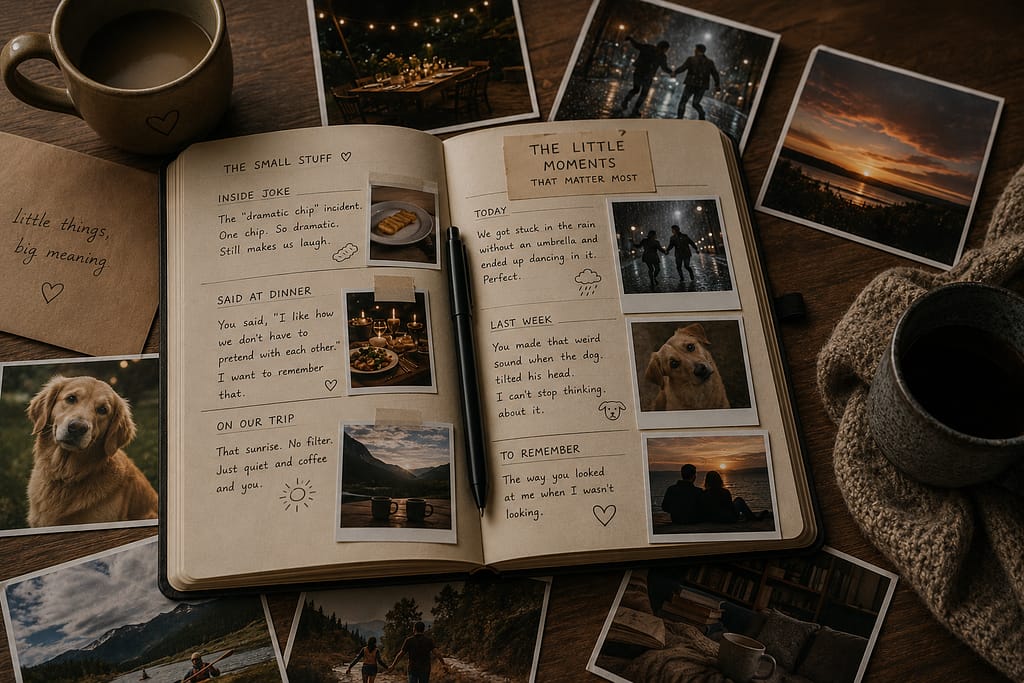
Relationship journaling is also a repository for the small things that fall through the gaps of ordinary life: the inside joke that’s already half-forgotten by the following week, the thing one person said at dinner that the other wants to remember, the moment on a trip that neither wants to lose. Written down in a relationship journal, these moments survive. Left to memory alone, they usually don’t.
Family Journaling: Capturing What Gets Forgotten
Children grow faster than parents expect, and the specifics — the mispronunciation that was endearing, the question that revealed a remarkable understanding of something, the game invented on a rainy afternoon — are lost faster than any photograph would suggest. Family relationship journaling is the practice of capturing these specifics before they dissolve.
A family memory logbook doesn’t need to be elaborate. The most useful family relationship journals are irregular but consistent: entries made when something happens that deserves to be kept, rather than on a forced daily schedule. A date, a brief description, the words actually said. A decade of entries like this is an extraordinary document — both for the adults who made it and for the children who will eventually read it.
For families with young children, family relationship journaling often becomes a developmental record as much as a memory book: first words, first sentences, the phase of asking ‘why’ about everything, the first time the child read something aloud. These milestones are well-documented in official terms but rarely captured in the texture of how they actually happened. The relationship journal captures that.
Older children can contribute to family journals directly — writing their own entries, answering questions that their parents have posed, drawing pictures with captions. A journal that contains multiple handwriting styles and voices across different ages of the same people is a remarkable artifact. It’s also a conversation starter for years: ‘Read what you wrote when you were eight.’
Playful Relationship Journaling: When It Doesn’t Look Like Writing
Relationship journaling doesn’t have to look like writing. Some of the most effective shared documents between couples and families are structured around play rather than reflection: prompt books, fill-in-the-blank journals, illustrated love letters, collaborative doodles with captions.
The value of a playful relationship journaling format is that it lowers the bar for participation. A notebook passed between two people with the instruction ‘write something’ can feel like an assignment. A notebook with the prompt ‘Draw a terrible portrait of the other person and describe what you drew’ produces laughter, effort, and a document that neither person will ever throw away.
Doodle journals — where both people contribute drawings, responses to visual prompts, collaborative illustrations — work for couples who don’t think of themselves as writers. The medium changes but the function of relationship journaling is the same: attention directed toward the relationship, captured in a form that persists.
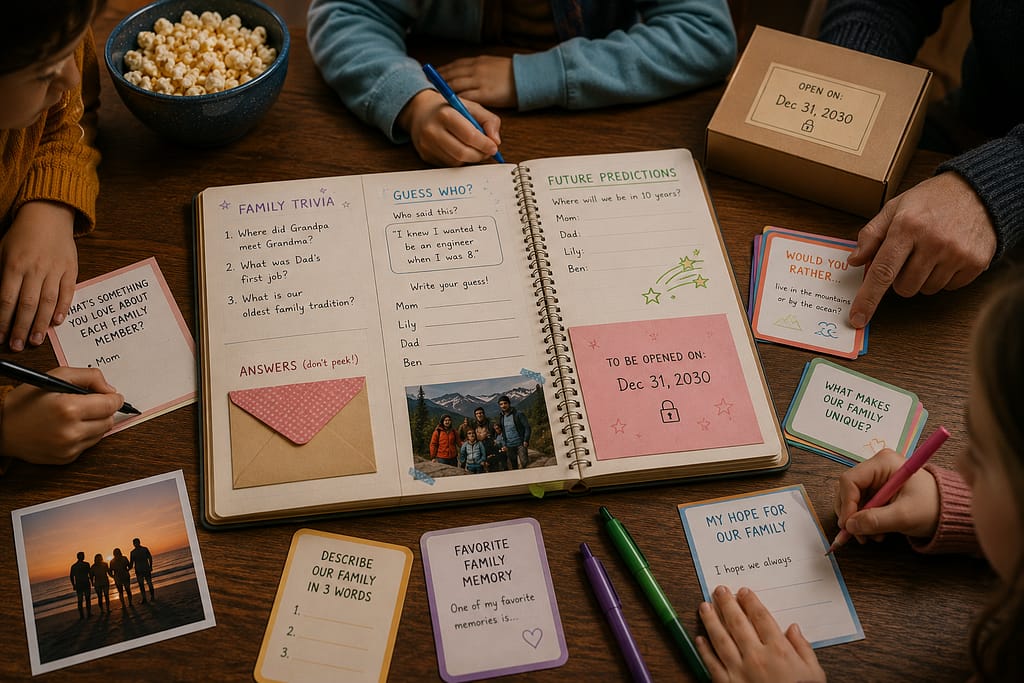
For families, game-format relationship journaling works well: trivia about family history, guessing games where answers are revealed later, predictions about the future written by everyone and sealed to be opened at a specific date. These formats make the relationship journal something everyone wants to use rather than something one person maintains and the rest tolerate.
Building the Habit: How to Start and Keep Relationship Journaling Going
Relationship journaling fails for the same reason any shared habit fails: it requires coordination between people, and coordination is harder than individual effort. The solution is to make the habit as low-friction as possible and to define it around a minimum rather than an ideal.
For a shared relationship journal between two people: agree on a frequency that’s sustainable, not aspirational. Once a week is better than every day. Once every two weeks is better than once a week if the once-a-week version only lasts three weeks. Define what counts as an entry: one paragraph, a list, a drawing, a response to a prompt. Anything that goes in the notebook counts.
Keep the relationship journal somewhere visible in the shared space — on the coffee table, on the kitchen counter, on a bedside table. A relationship journal in a drawer is a journal that requires remembering to use it. A journal that’s visible invites use.
For family relationship journaling: assign one person as the keeper — the person responsible for having the journal available and initiating entries — while making clear that anyone can contribute at any time. The keeper doesn’t have to write every entry; they just have to make sure the relationship journal doesn’t disappear into a drawer for six months.
What to Write When the Relationship Is Going Through a Difficult Phase
Relationship journaling is easiest when things are going well. It’s most valuable when they’re not. During periods of friction, distance, or conflict, the instinct is often to stop writing — the journal feels like a site of difficulty rather than a resource. The opposite approach serves better.
During hard periods, relationship journaling shifts function. The shared journal may be less active, and that’s fine. But personal journaling about the relationship — writing for yourself, not for the other person — helps you process what’s happening, identify your own contributions to the dynamic, and separate what you think from what you feel. These are useful distinctions that are hard to make without writing.
Some couples find that the shared relationship journal becomes more valuable, not less, during difficult periods — not as a site for processing conflict (that’s what conversation is for), but as a place to document the small positive moments that still exist even when the relationship is strained. Actively noticing and recording what’s still working is not denial. It’s a deliberate practice of balance.
Relationship Journaling as a Long-Term Project
A relationship journal kept over years becomes one of the most unusual and valuable documents a couple or family can possess. Unlike photographs, which capture surface; unlike messages, which capture fragments; relationship journaling over years captures the full arc — the periods of ease and difficulty, the things that mattered at different stages, the evolution of the people involved.
Some couples read back through their shared journal together, once a year or on an anniversary. This practice is not nostalgic in a passive sense — it’s an active review of the relationship’s history, which creates shared memory and shared meaning. The entries become part of the story both people tell themselves about the relationship.
For families, the multi-year relationship journal becomes a family archive — not the official record of events, but the interior record: what it felt like to be in this family, at this stage, with these people. That document has no substitute and no replacement. It’s worth building from the beginning, imperfectly, and keeping going.
Relationship journaling doesn’t require significant time or literary skill. It requires the decision to pay attention — to the other person, to the relationship, to the small moments that compose daily shared life. The practice is as simple as opening a notebook. The effect, over years, is anything but small.
The shared relationship journal is not a test of the relationship and not a performance. It is a record. Some entries will be brief; some will be longer. Some periods will produce many entries; others will produce few. What matters is that the relationship journaling practice continues and that the notebook keeps being treated as something worth the attention of a page.
Why Writing Together Builds a Different Kind of Connection
There is a version of communication that happens constantly in relationships — the task-oriented exchange of information necessary to manage shared life. What time is dinner. Did you call the plumber. What are we doing this weekend. This kind of communication is necessary and it is not connection. Connection requires the other kind of exchange: what you are thinking, what you are noticing, what matters to you right now.
Relationship journaling creates a dedicated space for that second kind of exchange. The act of writing, even in response to a simple prompt, is cognitively different from conversation. You cannot be interrupted. You have to finish a thought. You have to decide what you actually mean rather than adjusting in real time to the other person’s response. The result is often more considered, more honest, and more revealing than the equivalent spoken exchange.
Research on relationship quality consistently identifies two factors as central to satisfaction over time: the quality of communication between partners, and the experience of being known by the other person — not just their habits and preferences, but their interior life. Relationship journaling builds both. It generates better communication by creating a structured space for it, and it generates the experience of being known by making the interior life visible.
The Relationship Journal as a Record Worth Keeping
One of the underappreciated qualities of a relationship journal is what it becomes over time. In the early months of a relationship journaling practice, it is a tool — useful for communication, useful for connection. Over years, it becomes something else: an archive.
The archive of a relationship is not the photographs or the social media posts — those record surfaces. The relationship journal records the interior: what both people were thinking about at a particular point in the relationship, what they were grateful for, what they were finding difficult, what they loved about the other person at that specific stage. This record is unreplicable. Nothing else produces it.
Some couples designate a particular date each year — an anniversary, or any date that works — to read back through the previous year’s entries together. This practice is not just nostalgic. It is informative. It reveals growth, change, patterns, and progress that is invisible from inside the present moment. A relationship that has been relationship-journaled for five years contains more documented history, more mutual understanding, and more shared reference than one of equivalent duration that has not.
For research-backed insights on what makes relationships thrive, the Gottman Institute’s blog draws on over four decades of couples research — a useful companion to any journaling practice.
Explore the Scribovo Relationships & Family collection — couple journals, family memory books, and playful shared journals, available on Amazon.
Published by Scribovo — journals, logbooks and planners for thoughtful adults.