
Home organization is one of those things that most people attempt several times — usually after watching something online, or after a particularly chaotic week — and abandon within a month. The planning notebook gets used for two weeks and then ignored. The cleaning schedule becomes a list of things that didn’t get done. The system that seemed so rational on a Sunday afternoon falls apart by Wednesday.
This is not a failure of willpower. It’s a failure of system design. Most home organization approaches are too complex to maintain, too rigid to accommodate real life, or too abstract to translate into daily action. A home organization system that sticks is one that is simple enough to use when you’re tired, visible enough that everyone in the household can use it, and flexible enough to adapt as circumstances change.
This guide covers the principles of effective home organization, the specific tools and practices that make it work long-term, and links to deeper guides on the areas where most households struggle most.
Why Most Home Organization Systems Fail

The most common failure mode is ambition. Buying a complete home organization system — notebooks, labels, baskets, color-coded folders — and attempting to implement all of it at once is almost guaranteed to collapse. The cognitive load of maintaining a complex system is itself a source of the overwhelm it was supposed to solve.
The second failure mode is invisibility. A planner in a drawer is not a home organization tool. It’s a journal you don’t use. Home organization works when the system is visible — on the fridge, on the counter, somewhere everyone in the household encounters it without having to go looking.
The third failure mode is perfectionism. A home organization system you can only maintain when you’re fully on top of things is not a system. A real home organization system needs to be the thing you return to when things have fallen apart — easy enough to restart, flexible enough to accommodate the weeks when life doesn’t cooperate.
The principle that underlies all durable home organization systems: start with one habit, make it visible, use it consistently for a month before adding anything else.
The Paper-Based Home Organization System
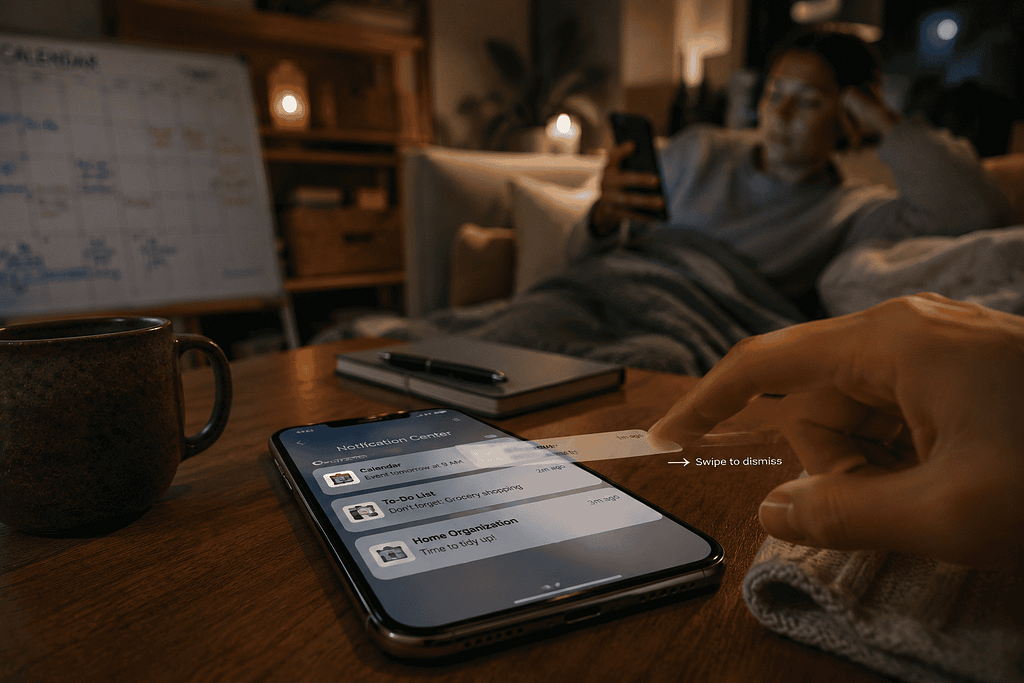
Digital tools for home organization have one significant weakness: they are easy to ignore. A notification can be swiped away. An app can go unopened for a week. A shared digital calendar requires everyone in the household to have the same app, the same account access, and the same habit of checking it.
Paper removes all of this friction. A weekly planning spread on the fridge is seen by everyone who walks past it. A home maintenance logbook on the kitchen counter gets picked up. The physical presence of a paper system creates accountability in a way that digital tools rarely do.
The core paper-based home organization system has three elements: a weekly planning spread covering appointments, deadlines, and household tasks; a running shopping and supplies list posted somewhere visible; and a home maintenance log recording what has been done, when, and what needs attention. These three elements, consistently used, cover the majority of household management.
Decluttering as the Foundation of Home Organization
Home organization cannot function in a home that contains too much stuff. The planner, the system, the schedule — all of it fails if the physical environment is overwhelming. Decluttering is not a one-time event before you start organizing. It’s the ongoing practice of keeping the household at a volume that the system can manage.
The most effective home organization declutters follow the same principle as the best organization systems: start small, be concrete, and finish before moving on. A wardrobe declutter done properly in a single afternoon is more useful than a whole-house project started and abandoned. One room, one category, one session.
The decision framework for decluttering is simple: is this item used regularly, does it still serve its purpose, and would I buy it again today? Anything that doesn’t pass at least one of those tests has a high chance of being better somewhere else — donated, sold, discarded, or passed on.
Room-by-Room: What to Track and Why
Effective home organization is not uniform. Different areas of the home have different management needs, and the system should reflect that.
Kitchen
Meal planning and grocery management are the highest-leverage habits in kitchen organization. A weekly meal plan — even a rough one — reduces decision fatigue, cuts food waste, and makes grocery shopping faster. A visible running shopping list means nothing essential gets forgotten. These two tools alone are responsible for more consistent, less stressful kitchen management than any storage solution.
Living Areas and Schedules
A monthly household calendar — physical, on the wall — is the home organization tool most households abandon and most consistently say they miss when it’s gone. The point is not to replace digital calendars. It’s to provide a shared physical reference point that everyone in the household sees without having to open anything.
Home Maintenance
Every home requires recurring maintenance — filter changes, appliance servicing, seasonal checks, repairs. Without a log, these things either get done inconsistently or not remembered at all. A simple home maintenance logbook recording what was done, when, and what needs attention next transforms reactive maintenance into proactive management.
Making Home Organization Sustainable
The difference between home organization systems that last and ones that don’t is almost never the quality of the planning. It’s what happens in the weeks when life intervenes — when someone is ill, when work expands, when the routine breaks. Systems that are designed to restart easily survive these moments. Ones that require continuous perfect adherence don’t.
Build in a weekly reset. Ten to fifteen minutes on Sunday — or whenever your week naturally turns over — to update the planner, check the shopping list, and note what needs attention. This single practice prevents the accumulation of disorder that makes restarting feel impossible.
Keep the system visible and the bar low. The home organization system you’ll actually use is the simplest one that covers your needs. The Scribovo Home & Organization collection includes the Cleaning Games planner and the Family Memory Booster Logbook — designed for households that need practical tools, not elaborate systems.
Bedroom and Personal Spaces: The Private Layer of Home Organization
Home organization in bedrooms and personal spaces has different logic from shared rooms. The goal isn’t household management — it’s personal maintenance: the small habits that prevent a private space from becoming a source of low-level daily stress.
The most useful home organization habit in a bedroom is the fifteen-minute tidy. Not a deep clean, not a reorganization — just returning things to their designated places and identifying anything that needs to leave the room. Done consistently, this prevents accumulation from becoming disorder.
For personal spaces, the key home organization question is visibility. Are the things you use daily accessible without having to move other things? If getting dressed in the morning requires navigating around obstacles, the space isn’t organized — it’s stored. Effective personal home organization reduces friction, not just clutter.
Getting Family Buy-In: Home Organization in Shared Households
Home organization systems fail in shared households for a specific reason: one person designed the system, and everyone else is expected to use it without having contributed. The solution isn’t a better system — it’s a more collaborative process for creating one.
Start with a conversation, not a plan. What aspects of the home feel disorganized to each person? What causes the most friction in daily life? The answers are often different, and the differences are informative. A partner who finds the kitchen hardest to manage and a partner who finds the schedule hardest to track need different home organization solutions.
Make the system visible to everyone, not just the person maintaining it. A weekly planner on the fridge works for shared home organization because everyone passes it and can add to it. A household calendar app that only one person manages is a calendar app that only one person uses.
Assign clear ownership without over-assigning. In a two-adult household, each person should be the default owner of specific recurring tasks — not because the other person never does them, but because ownership means someone notices when they’re not done. Diffuse responsibility produces tasks that fall through the gaps of any home organization system.
The Quarterly Reset: Keeping Your Home Organization System Current
Every home organization system decays over time. Not because people stop caring, but because life changes and the system doesn’t keep up. A child gets older. Someone changes jobs. A room’s function shifts. What worked six months ago no longer fits the current household.
The quarterly reset is the solution: a deliberate review, four times a year, of whether the current home organization system is still working. This doesn’t have to be long — thirty to forty-five minutes is enough. The questions to ask: what’s working well and should be kept? What’s not being used and should be simplified? What’s missing that would make daily life easier?
The timing aligns naturally with seasonal shifts, which is useful. Each season brings predictable organizational demands — clothing rotation, garden preparation, school-year transitions, holiday planning. A quarterly home organization review lets you get ahead of these rather than responding to them reactively.
Document the decisions from each review. A single page of notes — what changed, why, what you’ll reassess next time — creates a running record of how the household system has evolved. Over a few years, it becomes a useful reference for understanding what has and hasn’t worked in your specific home.
The Home Organization Mindset: Done Beats Perfect
The deepest obstacle in home organization is perfectionism — the belief that the system should be comprehensive, elegant, and fully working before it counts as real. This belief produces paralysis more reliably than any amount of clutter.
A home organization system that’s 70% implemented and consistently used is more valuable than one that’s 100% designed and never used. The kitchen calendar that gets updated every Sunday, even imperfectly, does more organizational work than the elaborate app that requires ten minutes to log a single task.
Start with the one thing that would make the most difference right now. Not the whole home organization system — one thing. Use it consistently for four weeks. Once it’s habitual, add the next. Built this way, over months, a home organization system becomes genuinely durable because each element has been practiced into habit rather than planned into place.
Starting Small: The One-Habit Entry Point to Home Organization
The most reliable way to begin a home organization practice is to choose one habit, make it as easy as possible, and use it for four weeks before adding anything else. Not a system — a habit. The specific habit doesn’t matter much. A weekly meal plan. A fifteen-minute Sunday tidy. A household calendar that gets updated every Monday morning.
What matters is that the habit is simple enough to do consistently and visible enough to prompt use. Home organization built from a single durable habit is more resilient than a complete system built in a weekend. The former can survive a disrupted week; the latter usually can’t.
After four weeks, the habit is either working or it isn’t. If it’s working, add one more element to the home organization system. If it isn’t, simplify rather than replacing — the problem is almost always that the bar was set too high, not that the category was wrong.
Home organization is, in the end, a practice of deciding what matters in daily life and making it visible. The system is a means to that end — not the goal itself. A well-organized home isn’t one that looks organized. It’s one that functions consistently, without requiring heroic effort to maintain.
If you’re looking for practical inspiration before building your own system, The Spruce’s home organization guide covers room-by-room strategies and storage solutions.
Explore the Scribovo Home & Organization collection — practical household planners and logbooks, available on Amazon.
Published by Scribovo — journals, logbooks and planners for thoughtful adults